

Technology
Beyond conventional damping. Beyond the unit cell.
Phynamics develops MRML Technology to expand the design space of dynamic response engineering, using purpose-designed mechanical metamaterials rather than treating vibration control solely as an added function.
Multi-Response Metamaterials Lattice
Three approaches to vibration control
Conventional vibration control
Dedicated devices or materials can be used to modify the response of a structure.
Mechanical metamaterials
Engineered architectures can produce dynamic behaviours beyond those of the base material alone. Repeating resonant cells are one representative approach.
MRML Technology
Our approach explores how tailored mechanical metamaterial architectures can address the overall dynamic response of a component.
CAD
Inside an MRML lattice
An MRML lattice can integrate regions with different resonant behaviour in one continuous structure. By varying the geometry of neighbouring regions and how they connect, we can shape how the component responds to vibration.
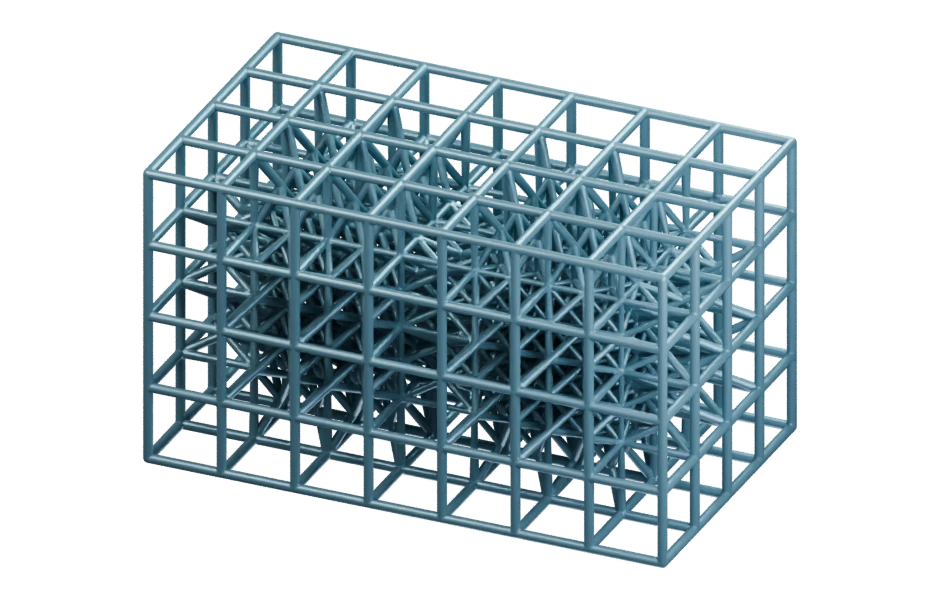
Graded lattice
The outer grid stays regular while the pattern of internal bracing changes across the lattice.
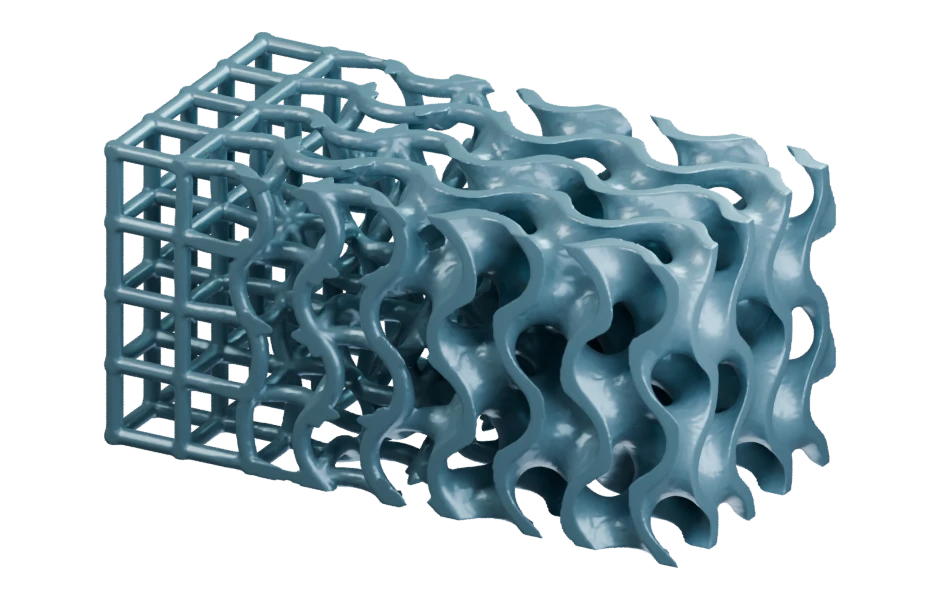
Lattice transition
A lattice made of struts joins a lattice formed by a continuous curved surface. The connection is part of the same geometry.
Design objectives
Design for the response that matters.
Target the dynamic response.
Explore selected frequencies, modes and directions of motion, including responses to attenuate and responses to retain or enhance.
Co-design dynamic and structural functions.
Define mass, stiffness, strength, geometry and manufacturing constraints alongside dynamic requirements.
Explore integration within the component.
Consider architectures that combine dynamic functions with the mechanical role of the part.
Engineering and validation
We assess candidate architectures against defined engineering requirements, using simulation and physical validation where appropriate.
Explore the validation methodInverse design in development
From target response to candidate architecture.
We are developing a dedicated inverse-design workflow for MRML Technology. The objective is to explore architectures against target dynamic responses while accounting for engineering and manufacturing constraints, and to evaluate selected candidates through appropriate simulation and testing. The software is being developed to support our engineering work and, in the future, MRML licensees.
Design inputs
Response, observation point, frequency band or modes, available geometry, mass, stiffness, materials and manufacturing process.
Architecture exploration
Compare candidates against the response target within the agreed constraints.
Expected outputs
A candidate architecture, a comparative response assessment and a validation plan.
Technology licensing
A technology designed for industrial collaboration.
Phynamics develops MRML Technology for application-specific engineering and potential technology licensing. Detailed technical exchanges can take place under appropriate confidentiality arrangements.
Explore how we workExplore the four application areas
Start with a non-confidential brief.